

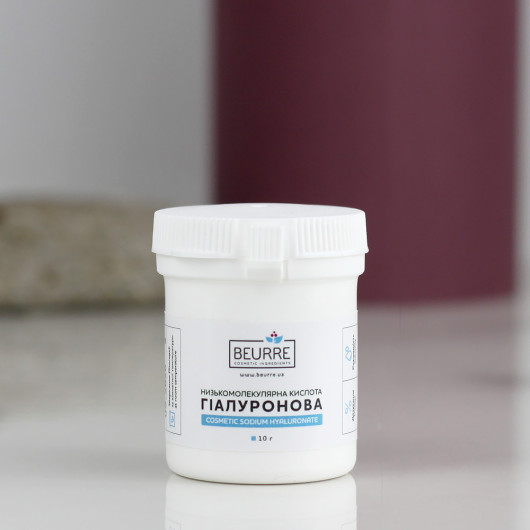
Hyaluronic acid, low molecular weight 5 g
| Producer: | China |
| Appearance: | powder |
| Solubility: | water soluble |
- Availability: In Stock
Low molecular hyaluronic acid in anti-aging cosmetics
Sodium salt of low molecular hyaluronic acid obtained by fermentation. Due to its small molecule size, it is quickly absorbed on the surface of the stratum corneum of the skin and absorbed. It provides deep and long-lasting moisturization of the skin and improves its elasticity. An indispensable ingredient for anti-aging care products and products for dry skin.
Characteristics of the component and specifics of use
INCI: Sodium Hyaluronate
Size: < 0.1 МDa
Dosage (percentage of input into cosmetics): 0,01 - 1 %. Do not use undiluted on the skin.
Solubility: dissolve in water. Pre-dispersion of hyaluronic acid powder in glycerin can accelerate further dissolution in water. Heating above 40 °C is not recommended.
Storage: long-term storage is recommended in a dark place at temperatures up to +25 °C, protect from direct sunlight and overheating.
Hyaluronic acid in cosmetics
Hyaluronate sodium is a non-sulfated glycosaminoglycan that is a constituent of skin and connective tissues. It is one of the main components of the extracellular substance, namely the extracellular matrix. Due to its ability to bind water at a ratio of 1000:1, it gives tissues elasticity. The water bound by hyaluronate is retained as a jelly-like substance and prevents the skin from “drying out” when the relative humidity of the atmosphere is reduced. In the body of a person weighing 70 kg on average contains about 15 grams of hyaluronic acid, a third of which is in the process of splitting or synthesis.


The hydrated state of the dermis is maintained by hyaluronic acid, which has the ability to bind 1000 times more water than it weighs itself. This distinguishes hyaluronic acid from other common “moisturizers” such as glycerin and sorbitol, compared to which it has the highest hygroscopicity (ability to bind water). Also, unlike them, it retains its ability to bind and retain moisture even in dry atmospheres. This property can be called the “diaper effect” - absorbed water is retained inside in the form of gel and does not evaporate even when the relative humidity of the surrounding air decreases. Along with a number of other substances hyaluronic acid is the main component of the extracellular matrix, which, in turn, and gives elasticity and clear contours of the skin.
After using cosmetics with hyaluronic acid, the skin looks softer, smoother and more delicate. And this is not just an external effect characteristic of most emollients. The fact is that the moist environment that hyaluronic acid creates near the skin surface reduces the evaporation of water through the stratum corneum, as the intensity of evaporation depends on the relative humidity of the surrounding air. This is significant because the permeability of the stratum corneum to water can increase dramatically when exposed to UV radiation, the damaging effects of surfactants and the pollutants that surround us everywhere.
Hyaluronic acid can temporarily “cover” the damaged stratum corneum, preventing the skin from dehydrating while the epidermis undergoes repair processes. In addition, the polymeric network that hyaluronic acid forms on the surface of the skin allows biologically active substances that are part of cosmetic products to linger on it longer, which increases the likelihood that they will penetrate the epidermis.
As we age, the skin's water balance is disturbed and water loss begins to exceed water gain. This occurs both by reducing the amount of moisture that seeps into the dermis through blood vessels (the overall blood supply to the skin deteriorates) and by disrupting the water-saving systems. In particular, the synthesis of hyaluronic acid in the dermis and epidermis is reduced and its destruction under the influence of various factors is accelerated.
The difference between low-molecular and high-molecular hyaluronic acid: which one to choose
As everyone knows, hyaluronic acid is usually divided into low-molecular and high-molecular. But what is the difference? And the difference is significant. First of all, in the size of the molecule itself. That, of course, affects the properties of hyaluronic acid. It has been found that hyaluronic acid of different molecular weights has different properties.
A comparison was made with high molecular weight hyaluronic acid with a molecular weight of 800kDA, an active cosmetic ingredient that has been used in cosmetology for a long time and is known for its unique moisturizing properties. The result showed that unlike 800kDa hyaluronic acid, which affects 40 genes, 50kDA hyaluronic acid significantly affects more than 120 genes, including key genes involved in the regulation of keratinocytes, as well as, genes that are responsible for the formation of complex compound complexes, such as occlusive and other CLAUDINS.
It turns out that the traditional component for the cosmetic market is high molecular weight hyaluronic acid, with a molecular weight of more than 800kDa. But, unfortunately, this molecule size is too large to get into the skin. Nevertheless, it is very effective in combating the loss of your skin's natural moisture and provides excellent instant hydration. That said, 50kDA low molecular weight hyaluronic acid is a much more effective form of HA, on a gene-regulatory level, than 800kDA HA.
Comparative tests of 50, 300, 800 and 1500kDa HA showed that HA with a molecular weight greater than 300kDa has very poor skin penetration properties.
Already after 5 hours of experimentation, 50kDa hyaluronic acid showed a threefold advantage, thus proving a direct correlation between the size of HA and its penetration abilities.
An 8-week comparative test was also conducted on female volunteers. 3 different hyaluronic acids with sizes of 50, 130 and 300kDa were tested.
The study showed that 50kDa HA can not only significantly improve skin softness, but also has significant anti-wrinkle properties. While the most popular 800kDa type of HA in cosmetics does not have such properties, but only provides a superficial moisturizing effect.
Thus, low-molecular hyaluronic acid with a molecular mass of 50kDa has optimal skin penetration properties compared to high-molecular hyaluronic acid, and accordingly has an effect on the expression of many genes, including those responsible for keratinocyte differentiation and the formation of intercellular complexes of compounds, the production of which decreases with age. The study confirms that superficial application of hyaluronic acid improves skin health, promotes normal skin function, and has a proven anti-aging effect. Hopefully, this information will help you make the right choice.
It can be concluded that high-molecular and low-molecular hyaluronic acid are equally beneficial for the skin, but have different effects
- Improvement of skin condition, normalization of its functioning, as well as anti-aging effect are inherent in low-molecular hyaluronic acid
- instant surface moisturizing and preventing the loss of skin's natural moisture is achieved thanks to the properties of high-molecular hyaluronic acid.
Handmade cosmetics recipes and reviews
If you are new to cream making - it is very difficult to make your own right recipe. And that's where we are ready to help you. Go to youtube channel Cosmetic Kitchen Beurre, where we have already developed many recipes for handmade cosmetics and share the technology of making cosmetics with their own hands. And also go to Beurre's Blog, where we share useful information about creating the right natural cosmetics.
| Товар | |
|---|---|
| Producer: | China |
| Appearance: | powder |
| Solubility: | water soluble |