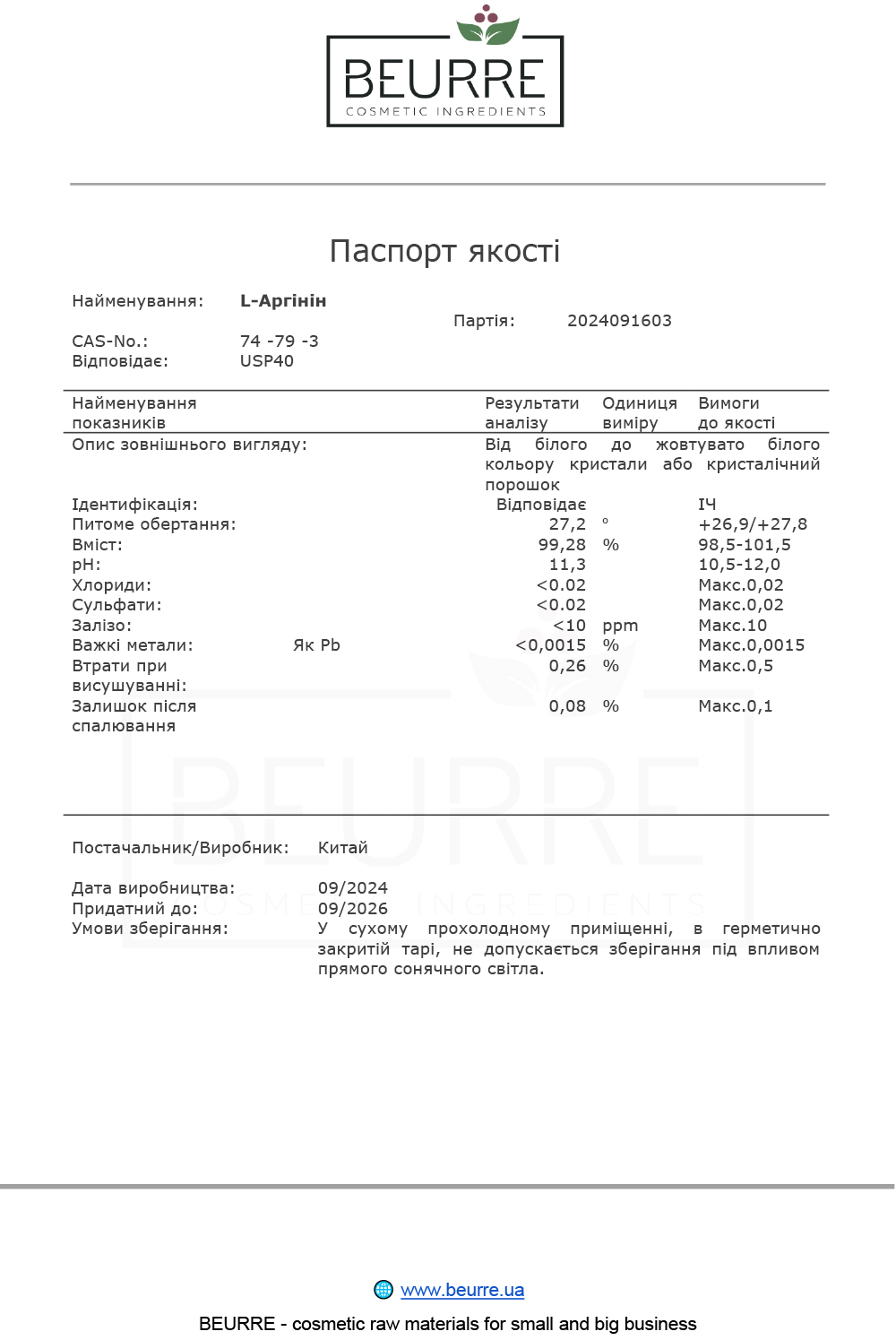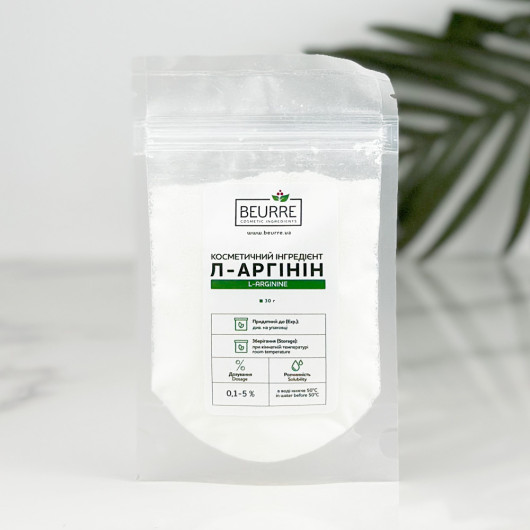
L-arginine amino acid 30 g
| Appearance: | powder |
| Solubility: | in the water |
| Origin: | synthetic |
| Type: | increases pH |
- Availability: In Stock
L-arginine - a multifunctional active for cosmetics
Arginine is an amino acid that is part of the NFM (natural moisturising factor), it is also part of the hair. Arginine amino acid is a very popular component in cosmetics. L-arginine - the synthetic analogue is a fine white crystalline powder that dissolves easily in water. This component performs a number of positive actions on our skin, because of which you should pay attention to it.
Characteristics of the component and features of use
INCI: L-arginin
Dosage: 0.1 - 5%
Usage: l-arginine amino acid should be dissolved in the aqueous phase or active phase of a cosmetic product and added to a warm emulsion. Do not heat above 50 C.
Storage: in a dark, dry place at a temperature up to 25 C. Keep away from moisture. Keep away from moisture.
Properties of L-arginin in the recipe
- Strengthens the vascular network Improves the process of collagen synthesis
- Promotes skin moisturisation
- Protects the skin from ultraviolet radiation Is an anti-ageing component
- Accelerates healing of skin damage and scars
- Has antioxidant properties
- Counteracts skin photo-aging and hyperpigmentation, promotes brightening
- Narrows pores, Normalises sebum production
- Smoothes skin micro-relief
- Acts as a keratolytic in maximum dosage.
L-arginine for skin
This active component is able to significantly increase the level of skin hydration, this is due to the fact that the amino acid helps to synthesise NUV components - urea, glycosaminogycans, as well as cholesterol and ceramides. Thus, L-arginine becomes a component that significantly strengthens the stratum corneum and protects it from environmental influences. L-arginine is able to significantly increase collagen production. Once this amino acid enters the skin, it is converted into L-proline, which in turn is the building material for collagen fibres. Collagen production helps to reduce the signs of skin aging, restore its elasticity, in addition, increased collagen synthesis contributes to faster healing of wounds and smoothing of scars. This allows the component to be used in cosmetics for post-acne skin. L-arginine is a powerful antioxidant, it is able to neutralise free radicals that damage skin cells and accelerate the aging process. L-arginine is simply indicated for skin with couperose. As it is able to significantly strengthen blood vessels and improve blood circulation, and therefore the nutrition of all tissues of the body. L-arginine is one of the few components, along with almond, glycolic and lactic acid, that are authorised for peeling sensitive skin and skin with couperose.
L-arginine for hair
This cosmetic component is good to include in recipes for the scalp, as it improves blood supply to hair follicles, normalises hair growth and nourishment. This component envelops the hair, makes it stronger and firmer, contributes to significant moisturisation of the hair shaft. It is desirable that arginine is on the hair longer than shampoo or rinse, so it is better to add it to masks or indelible hair products. Then the benefits will be more significant. In hair cosmetics, arginine can also be used as a component that softens the effect of surfactants.


Combination of L-arginine with other cosmetic ingredients
L-arginine works well in synergy with active ingredients. It can be combined with other amino acids, e.g. keratin, silk amino acids, works well in formulations with coenzyme Q10 and B vitamins (D-panthenol, ideal in conjunction with niacinamide), as well as C, E, A. In hair cosmetics, L-arginine creates a synergy with MSM sulphur. All these components significantly enhance the action of each other.
Dosage of L-arginine in cosmetics
The component can be added to various cosmetics from foaming washes to creams and serums. It is very good to add arginine to after-sun cosmetics. Usually L-arginine is added to the recipe in a dosage from 0.1 to 5 %.
- Moisturising creams, creams for sensitive skin - 0.1 - 1 %
- Cosmetics for skin with couperose and rosacea - 0.1 - 2 %
- Creams against hyperpigmentation - 2.5 -3 %
- Creams healing for scars and scars - 1,5 %
- Anti-age serums - 3-4 %
- Peeling for skin with couperose and sensitive skin - up to 5 %
- In the composition of serums with Botox effect - up to 4 %.
L-arginine to increase the pH L-arginine can be used to increase the pH of cosmetics, as well as alkali and baking soda. The pH of a 10% solution of L-arginine from BEURRE is 11.08. It should be added to your cosmetic product dropwise, mixed thoroughly and monitored acidity level using a pH meter or indicator strips.
Handmade cosmetics recipes, formulas and reviews
It is very difficult to create your own correct recipes if you are new to cream maker. And we are ready to help you with this. Go to the YouTube channel Beurre Cosmetic Kitchen, where we have already developed many recipes for handmade cosmetics and share the technology for making cosmetics with our own hands. And also you can check Blog from Beurre, where we share useful information about creating the right natural cosmetics.
| Товар | |
|---|---|
| Appearance: | powder |
| Solubility: | in the water |
| Origin: | synthetic |
| Type: | increases pH |
Viewing the analysis certificate is only available to registered users. Register or log in