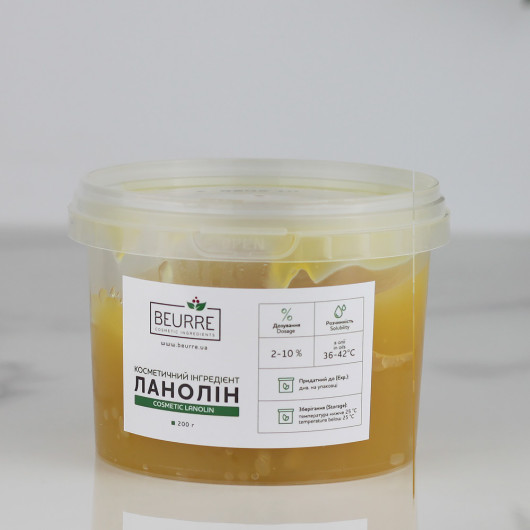
Anhydrous lanolin is a natural wax for cosmetics of animal origin But what is it? Let's understand in detail. Anhydrous lanolin is a thick viscous mass that is actively used in cosmetology and medicine. The main properties of this component are moisturising, nourishing, softening and protective. It is a unique mixture of fatty acids and esters of high-molecular alcohols, such as cholesterol and isocholesterol, and free high-molecular alcohols. However, the full composition of lanolin is not fully understood and includes a combination of over 200 different substances, and the composition can vary depending on the breed of sheep. How is lanolin produced? Anhydrous lanolin is an animal wax, also known as wool wax, because it is formed on the wool of sheep. It is obtained by boiling the wool. Initially, it is a substance with a rather pungent specific odour and various impurities. However, the modern cosmetic industry has learnt to purify lanolin from extraneous impurities. Slightly noticeable characteristic odour of lanolin still remains, but in the finished product it is imperceptible. So lanolin pharmakopeinny pharmakopein can be used even for the creation of lipsticks. Properties of lanolin in cosmetics According to its composition, anhydrous lanolin is very close to the fat that is released by human skin, which means that this component is well accepted by the skin. Creams, in the composition of which there is lanolin, easily absorbed. But only if the lanolin comes as a co-emulsifier. This component is completely inert, stores well and is not prone to rancidity. Lanolin is a good moisturiser. We have written about it above, but let us reinforce our words with a detailed theory: firstly, it creates a breathable occlusive layer and prevents transepidermal moisture loss, simply put, excessive evaporation from the skin. This component can easily replace petroleum jelly in terms of its properties when creating an occlusive layer. That is why lanolin is simply irreplaceable in winter cosmetics during the heating season. secondly, lanolin is able to retain quite a large amount of moisture. One molecule of lanolin can hold a large amount of water. Therefore, it is a good addition to moisturising creams. Lanolin is able to soften rough skin, heal small wounds and cracks. All women know that with the help of lanolin can cure cracks on the nipples, which can be formed from breastfeeding a baby. In addition, this component is ideal for the cold season, as it protects the skin from temperature changes. How to work with lanolin Anhydrous lanolin is a viscous, thick, wax-like mass with a yellowish to light brown colour. As lanolin can bind water, it can be used as a co-emulsifier, and when making recipes with lanolin, the dosage of the main emulsifier can be reduced so that the cream does not become too thick. Lanolin stabilises the emulsion, making it thicker, but emulsions with lanolin absorb well. Anhydrous lanolin is usually added to the fatty phase together with emulsifier, oils and emollients and then the two phases are combined using a mini-mixer. Dosage of vegetable lanolin Unlike vegetable lanolin, lanolin of animal origin should not be used pure on the skin, as it can clog pores and is difficult to apply due to its high viscosity. In its pure form, it can only be used to lubricate the nipples during lactation. Since it heals cracks well and softens the skin. And wash off before feeding lanolin is not necessary, it is safe for babies. Sheep lanolin can be introduced without fear in the following cosmetics: in creams added from 1 % to 10 %, in lip care products from 1 to 15 % therapeutic products - up to 25 % in soaps from scratch up to 10 % To solve what problems can be used: nourishing and protective creams for all parts of the body, lanolin is particularly good for rough skin on elbows and feet emollients for dry and very dry skin on the face and hands coldcreams for all skin types, as lanolin creates a protective layer and allows the use of creams, before going outdoors wrinkle creams eye creams children's cosmetics in lipsticks and balms for shine, nourishment and moisturising of lips in sun protection properties in nail and cuticle care products hair products, especially in the care of very dry hair (masks, conditioners) Lanolin in soap from scratch Lanolin is a good addition to soap. It can be added along with oils when making soap cold process soap, but be sure to factor it into the recipe and enter it into your soap calculator. In hot milled soap from scratch, lanolin is best added as a gelling agent. It adds conditioning properties to the soap, the lather in lanolin soap is creamy and soft. This component makes the soap more gentle on the skin. However, a high percentage of lanolin in soap can affect its hardness. In this case, you simply need to give the soap more time to mature.