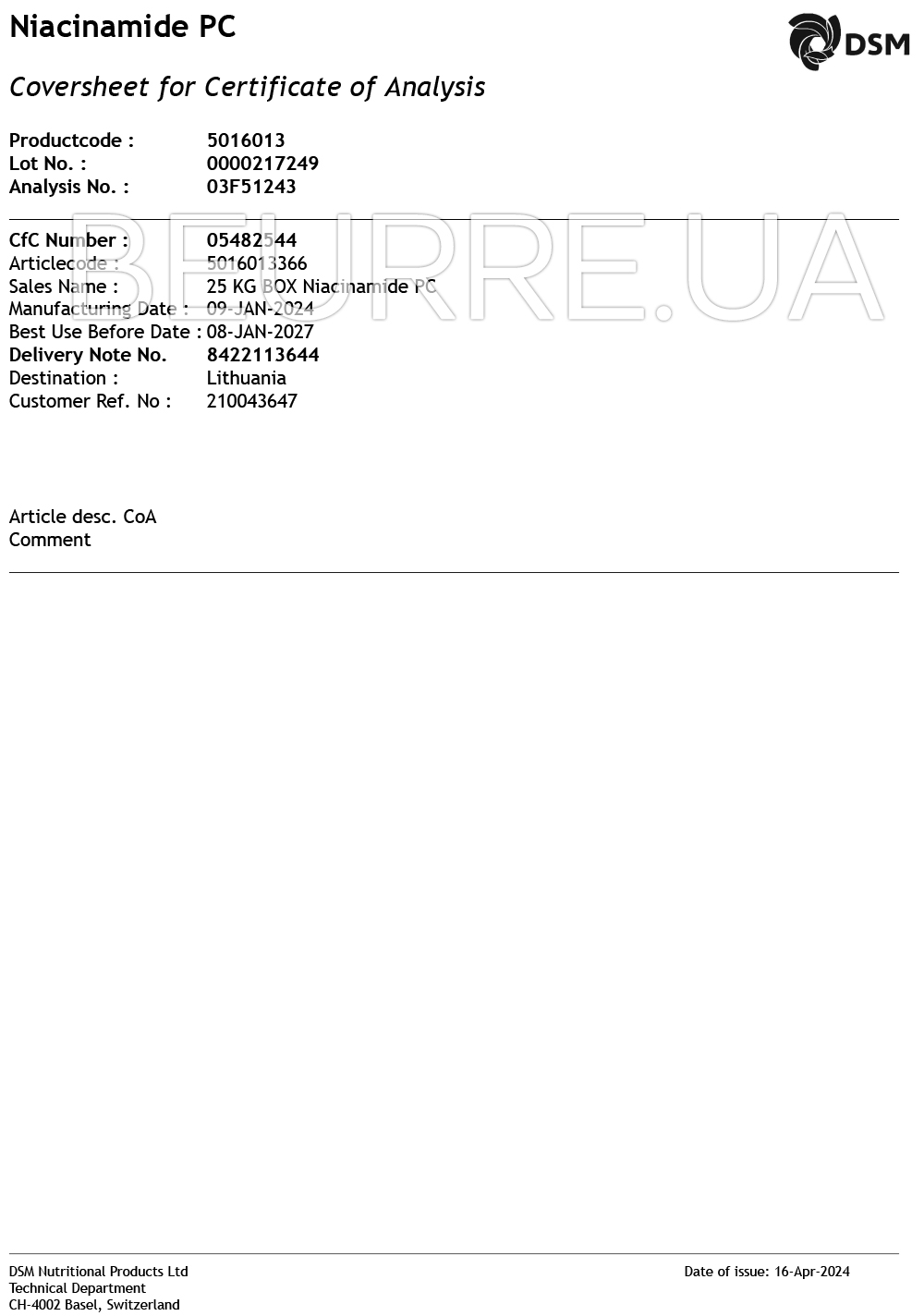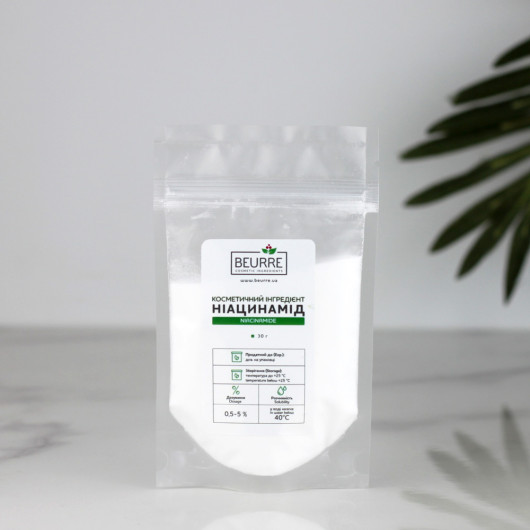
Niacinamide (vitamin B3) 30 g
| Producer: | DSM |
| Appearance: | powder |
| Solubility: | water soluble |
| Certification | VEGAN, HALAL, CHINA LISTED |
- Availability: In Stock
Niacinamide PC - vitamin to protect hair and facial skin
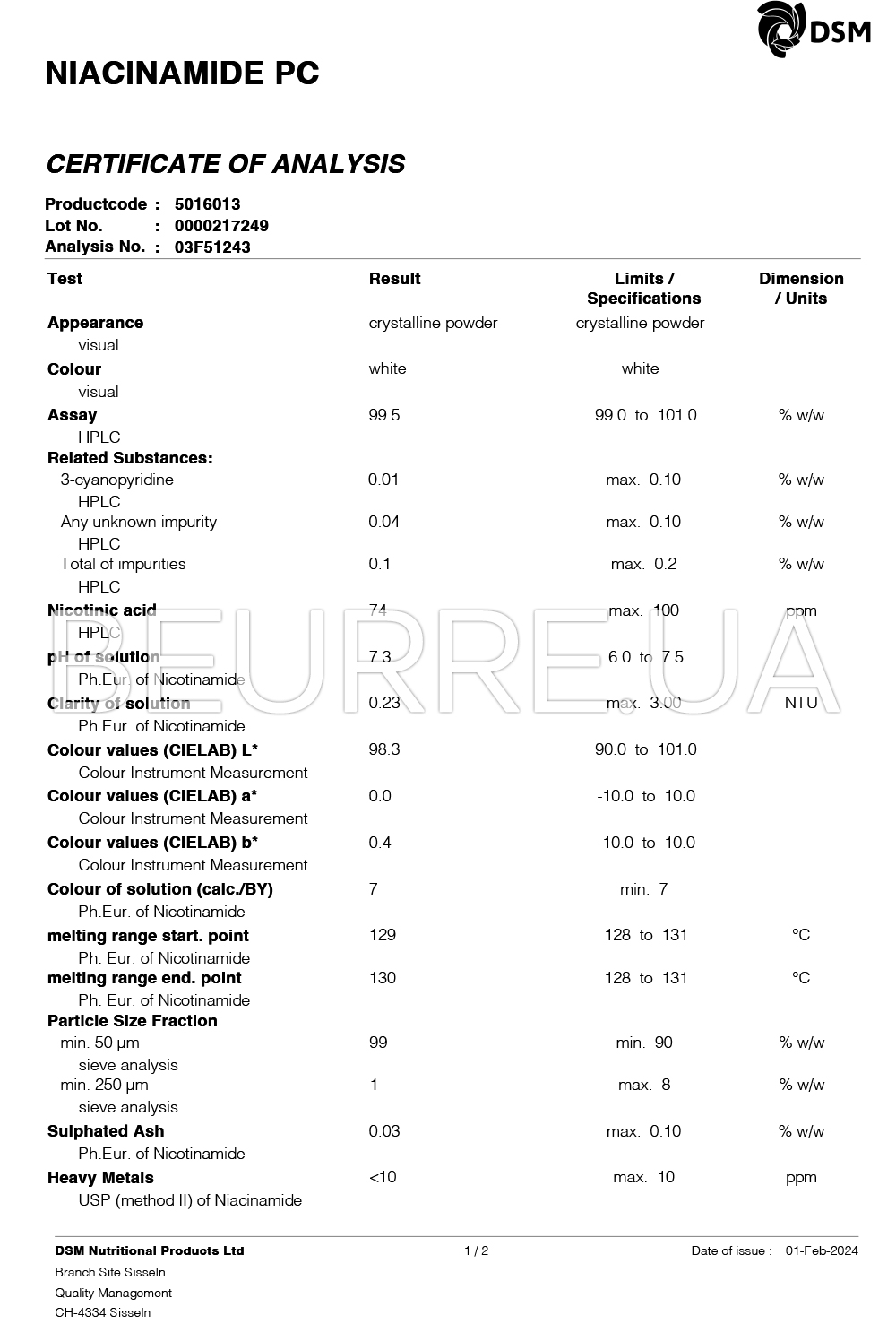
A modernised version of the Niacinamide vitamin that provides all the benefits of vitamin B3, minimising possible unwanted effects. Beurre's Vitamin B3 contains less than 100 ppm of residual nicotinic acid, making it well tolerated by our skin. The active acts as a powerful antioxidant, sanitises the skin and fights pathogenic bacteria. But above all, it is appreciated for the fact that it actively stimulates blood circulation, thanks to which vital regenerative processes are launched in the skin cells.
Characteristics of the component and features of use
INCI: Niacinamide
Appearance: white crystalline powder without odour
Dosage: 0.5-5% (allowed to enter up to 7%)
Solubility: easily soluble in water at room temperature, as well as alcohol and glycerine
Features of use: allowed to heat up to 70 C. The recommended acidity of the finished cosmetics should be within 4.0 - 7.0. Niacinamide is incompatible with strong acids, which may cause hydrolysis to nicotinic acid. For the same reason it is desirable to avoid combining with enzymes (enzymes).
Storage: in a dark, dry place out of direct sunlight.
Origin of niacinamide (vitamin B3)
The Swiss company DSM was one of the first to produce beauty vitamins and the first to explore their potential as active ingredients for use in cosmetics. Ten years ago, DSM developed Niacinamide PC, a form of vitamin B3 optimised for cosmetic use. Now they have launched a new, updated version of this popular ingredient that simplifies its use in cosmetic formulations. Niacinamide is of synthetic origin and its chemical formula looks like this:

Niacinamide PC applications in cosmetics
It's tempting to think we know everything about niacinamide. But this highly effective and easy-to-make form of vitamin B3 can still surprise. The special release form causes no side effects to the skin, and makes it easy to work with the ingredient.
As far as cosmetic properties are concerned, we would like to mention the special effect of niacinamide in increasing the skin's protection against UV radiation and blue light. Unique DSM studies have also confirmed the protection of the skin against pollution, which is especially important for people living in big cities.


DSM's own recent research has shown that it can prove to be a powerful ally in solving many of the problems facing the beauty industry: preserving skin health from environmental pollution, as well as from the negative effects of sunlight and blue light.
Reducing skin damage caused by UV radiation and blue light
Exposure to sunlight during the day, together with the natural ageing process, causes premature ageing of our skin. UV radiation also causes excessive or uneven skin pigmentation and sometimes the development of skin cancer. Niacinamide has proven its effectiveness in fighting UV damage: it protects and revitalises UV-exposed skin to preserve its beautiful radiance and elasticity. Therefore, this ingredient is recommended for inclusion in day and sunscreen cosmetics.
Blue light from sunlight, computer or smartphone causes the same effects as UV radiation and penetrates even deeper into the skin.
One of the most studied causes of blue light-induced skin damage is the formation of reactive oxygen species (ROS). This was the first marker that DSM investigated. To fully protect the skin from all types of radiation, it is recommended to combine UV filters with protection against type A and B rays, or use universal actives such as Enhance U-S or Tinosorb S Lite Aqua, which can provide protection against all types of radiation.
Going back to blue light specifically, it has long been shown to significantly increase oxidative stress in the skin by awakening reactive oxygen species (AFCs). AFCs, in turn, can cause damage to proteins and lipids. This graph shows the result of using 3% niacinamide in cosmetics and its effect on reducing the induction of AFCs. As can be seen from the graph, the application of niacinamide significantly reduces AFC on the skin after blue light irradiation.

UV-induced DNA damage repair
Niacinamide has been shown to enhance DNA damage repair in human keratinocytes and human skin. In the study presented below, ex vivo skin was treated with 50 μM niacinamide prior to exposure to low-level Solar Simulated UV (ssUV). The percentage of epidermal Cyclobutane Pyrimidine Dimer (CPDs) was quantified by immunostaining. DNA damage directly leads to CPD formation.
The graph shows that niacinamide significantly enhances photodamage repair in human skin.

Reduction of skin pigmentation
Testing of the brightening properties of niacinamide was conducted on a model of restored human skin where PTU (phenylthiourea) and Niacinamide PC were applied daily for 13 days. The pigmentation changes of the 3D skin model were monitored using a Minolta CR 300.2 chromometer.

As a result, you can see the result of skin lightening compared to placebo in the 3D skin model.
In vivo testing provides further evidence for the efficacy of niacinamide with respect to skin lightening (by inhibiting melanosome movement). Its efficacy can already be confirmed at a use level of 2%. 5% niacinamide has shown no side effects and is recognised as safe. Its bleaching properties are also interesting in the fight against post-acne, age spots and melanoderma.
Combating skin aging
Niacinamide increases collagen synthesis, reduces skin dryness, and gives skin elasticity, which helps to reduce wrinkles. Several in vivo clinical trials have demonstrated significant improvements in female volunteers from the Caucasus, Japan and Taiwan. Below is a 12-week study with graphs showing the result on the left and right side of the face. The result of 5% niacinamide shows significant improvement in fine lines and wrinkles after 8 and 12 weeks of daily application.

Seboregulation and purification of oily skin
Niacinamide is able to reduce sebum production and also improve the exfoliation of dead skin cells. This action has a positive effect on the problem of oily skin and acne, and together with this vitamin B3 reduces inflammatory reactions of the skin.

Corneocare or strengthening of the skin's protective barrier
Niacinamide RS provides a strong epidermal barrier by increasing the levels of ceramides and free fatty acids in the stratum corneum. The use of cosmetics containing 2% niacinamide results in a 67% increase in the level of fatty acids and a 34% increase in the level of ceramides.
Cosmetic properties of renewed vitamin B3 in cosmetics
- protects the skin from external urban pollutants
- soothes damaged and irritated skin
- moisturises well and gives a feeling of comfort
- evens skin tone, removes dullness
- slows down the aging process and removes wrinkles
- prevents age spots
- brightens the skin
- protects against UV and blue light
- has sebum-regulating properties
- improves skin elasticity
- helps treat acne
- shrinks pores
- restores the skin barrier
- has a powerful antimicrobial effect
- stimulates blood circulation, which actively affects hair growth.
We all know that exposure to sunlight has a negative effect on our skin and accelerates the premature aging process. UV radiation also causes excessive or uneven pigmentation and can also promote the development of cancer cells. Niacinamide is proven to fight UV damage: it protects and repairs UV-exposed skin to maintain its beautiful radiance and elasticity.
Benefits of using Niacinamide PC
- Niacinamide PC up to 5% is easily dissolved in water and very easy to use
- tolerates a wide pH range (4.0 - 7.0)
- effective even in severe skin conditions
- resistant to light, heat, reducing and oxidising agents
- works to maintain DNA stability.
In which formulations it is recommended to include Niacinamide PC
- in creams for sensitive and damaged skin
- in anti-ageing day and night creams and emulsions
- in daily moisturising serums
- in day cosmetics and after-sun cosmetics - as a photoprotective agent
- in whitening cosmetics and age-reducing hyperpigmentation agents (in combination with other whitening agents)
- in cosmetics for youthful oily skin prone to acne
- in complex treatments for atopic skin.
Handmade cosmetics recipes, formulas and reviews
It is very difficult to create your own correct recipes if you are new to cream maker. And we are ready to help you with this. Go to the YouTube channel Beurre Cosmetic Kitchen, where we have already developed many recipes for handmade cosmetics and share the technology for making cosmetics with our own hands. And also you can check Blog from Beurre, where we share useful information about creating the right natural cosmetics.
| Товар | |
|---|---|
| Producer: | DSM |
| Appearance: | powder |
| Solubility: | water soluble |
| Certification | VEGAN, HALAL, CHINA LISTED |
Viewing the analysis certificate is only available to registered users. Register or log in