

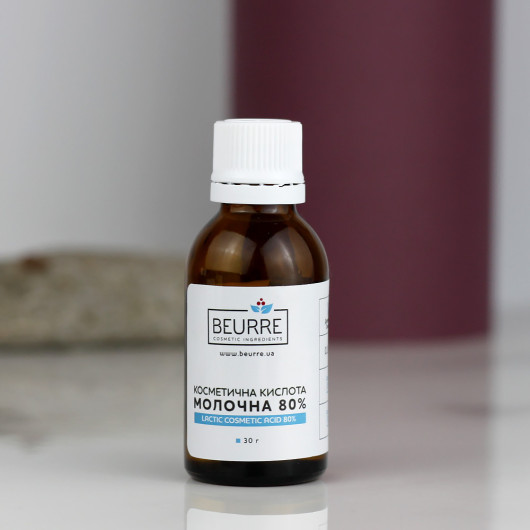
Lactic acid 30 g
| Producer: | China |
| Appearance: | liquid |
| Solubility: | water soluble |
| Type: | lowers pH |
- Availability: In Stock
Lactic acid and its use in cosmetics and as a peeling agent
Lactic acid is a colorless or slightly yellowish syrupy transparent liquid with a sour taste and a weak specific odor. Refers to alpha-hydroxy acids (AHA), non-toxic. It is obtained by fermenting sugar-containing and lacto-containing raw materials with lactic acid bacteria.
Precautions for using cosmetic acids can be found in the article from Beurre "Preventive measures when working with AHA/BHA acids".
Component characteristics and features of use
INCI: Lactic acid
CAS № 79-33-4
Content of the main substance: 80%
Density: 1.2 g/ml
Solubility: in water, alcohol, glycerin
Recommended dosage: when using lactic acid at home, it is recommended to use it in the form of no more than a 4% solution. For creams and tonics, the optimal dosage is 0.1-0.5%.
Features of use: incompatible with xanthan (destroys its structure).
Caution: In summer, it is not recommended to use cosmetics containing a high percentage of lactic acid. During periods of high solar activity, young cells are most exposed to UV radiation, which can contribute to skin pigmentation. Therefore, in summer, it is recommended to combine the use of cosmetics containing lactic acid with products containing UV filters, skin-soothing ingredients, and substances that reduce melanin production. Never apply cosmetics containing lactic acid to damaged areas of skin!
Storage: in a dark, dry, cool place.
Use of lactic acid in soap making
Recommended addition for soap from scratch: up to 3% lactic acid in water, before adding alkali. It should be especially noted that each gram of this acid is additionally neutralized by 0.36 g of alkali (NaOH).
CAUTION! When making soap, before adding alkali, the lactic acid solution should be cooled (or replace some of the water with ice), otherwise the reaction will be accompanied by strong bubbling.
As a result of the interaction of lactic acid and alkali, sodium lactate is formed. And this is one of the most powerful moisturizers. It not only has a bleaching effect, but also helps improve foaming. In addition, it is sodium lactate that gives the finished soap a conditioning property. An undoubted advantage of soap made with the addition of lactic acid is that it takes less time to make: such soap can be removed from the mold much earlier. The addition of lactic acid helps the soap to be more attractive on the outside due to its smoothness, "glossy".
Cosmetic properties
- Moisturizes. Lactic acid is part of the natural moisturizing factor (NMF) - a complex of substances with moisture-retaining properties.
- Exfoliating. Like all alpha hydroxy acids, it breaks down protein bonds between the keratinized cells of the stratum corneum. As a result, the cells exfoliate and are washed off the skin surface. The skin becomes smoother and more even. This property helps to eliminate traces and scars after acne and prevent the formation of clogged pores, since the scales in the strait do not stick together, but are promptly removed from the skin, while the pores narrow. Therefore, lactic acid is used in products for oily, problematic skin. It gives a positive exfoliating effect with increased keratinization of the skin (keratosis). In anti-aging cosmetics, it stimulates the process of cell renewal, which slows down with age.
- It causes less irritation than glycolic acid. Lactic and glycolic acids have similar properties, but the lactic acid molecule is larger than the glycolic molecule and consists of three carbon chains, and the glycolic molecule consists of two. Due to this, lactic acid penetrates the skin more slowly and acts more moderately. The likelihood of skin irritation and unwanted complications is reduced.
- Improves the condition and thickness of the epidermis. “According to the results of the studies, the thickness of the forearm skin, to which either a lotion containing 25% glycolic acid or lotions containing 25% lactic or citric acid was applied for 6 months, becomes 25% thicker compared to the skin of the control arm (to which a placebo lotion containing no AHA was applied). At the same time, an increase in the thickness of the living layer of the epidermis is observed, as well as an increase in the content of mucopolysaccharides, an increase in the density of collagen and an improvement in the condition of elastin fibers in the papillary layer of the dermis” (Margolina Anna).
- Antimicrobial. Lactic acid is part of the acid mantle of the skin. An acidic environment is destructive for many microorganisms, so they cannot live and reproduce in it. Thus, the skin is protected from the development of pathogenic microflora. Lactic acid acts mainly against bacteria, especially anaerobic ones, but is not very effective against yeasts and molds. Therefore, it makes sense to combine lactic acid with benzoic and (or) sorbic acids.
Rules for the use of lactic acid
- mandatory use of UV filters in cosmetics;
- it is preferable to introduce into the formulation components that reduce melanin synthesis, in particular arbutin, contained in bearberry and licorice;
- the optimal value in terms of tolerability and effectiveness is considered to be pH 3-3.5, in a neutral environment (pH 7) the ability of AHA to stimulate skin cell renewal practically disappears;
- for daily home care, it is recommended to use products with an acidity above 3.5 and a concentration of no more than 10%;
- test the preparations for tolerability on a small area;
- do not apply AHA to the area around the eyes and lips, where the skin is especially thin, use with caution on sensitive skin;
- it is recommended to introduce antioxidants into the formulation, as well as skin-soothing components;
- lactic acid is introduced at the end of the preparation of the cosmetic product.
Handmade cosmetics recipes, formulas and reviews
It is very difficult to create your own correct recipes if you are new to cream maker. And we are ready to help you with this. Go to the YouTube channel Beurre Cosmetic Kitchen, where we have already developed many recipes for handmade cosmetics and share the technology for making cosmetics with our own hands. And also you can check Blog from Beurre, where we share useful information about creating the right natural cosmetics.
| Товар | |
|---|---|
| Producer: | China |
| Appearance: | liquid |
| Solubility: | water soluble |
| Type: | lowers pH |
Viewing the analysis certificate is only available to registered users. Register or log in
