

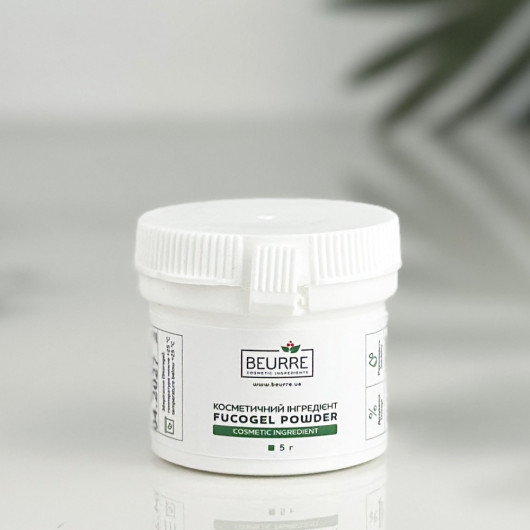
FUCOGEL powder 5 g
| Producer: | Solabia |
| Appearance: | powder |
| Solubility: | in water |
| Origin: | vegetable |
| Certification | Ecocert/Cosmos |
- Availability: In Stock
Natural polysaccharide for moisturizing skin and hair
Fucogel (Fucogel) is a fucose-based polysaccharide that affects skin cell communication. It is recognized as a multifunctional reference component in cosmetics that has an immediate soothing, moisturizing, anti-aging and regenerating effect on the skin. Fucogel enhances the feeling of comfort after using cosmetics with it. The active moisturizes the hair, forming a protective film on it and has an effect similar to silicones. The powder form of Fucogel was chosen by Beurre store for a reason, because the powder is a concentrated form, free of preservatives, certified by Ecocert/Cosmos and allows you to save money on transportation costs. Also, the dry form of the active allows it to be included in mineral cosmetics.
Fucogel is available in two forms: dry concentrated powder Fucogel powder, the % of input of which in cosmetics is 0.1 - 1%. And liquid form Fucogel 1.5P, which is a solution of concentrated Fucogel powder in water and preserved with Phenoxyethanol. The standard % input is 1-10%, but up to 20% is allowed if necessary.
Characteristics of the component and specifics of use
INCI: Maltodextrin (and) Biosaccharide gum-1
CAS №: 9050-36-6 (Maltodextrin)
CAS №: 194237-89-3 (Biosaccharide gum-1)
Appearance: fine powder with white to beige color.
Origin: Fucogel powder is obtained by bacterial fermentation from non-GMO plant substrate, has a high molecular weight (1.106 Da). It contains L-fucose, D-galactose and galacturonic acid.
Dosage (percentage of input into cosmetics): 0.1% - 1%. Do not use undiluted on the skin.
Solubility: in water at temperatures up to 45 C. Short-term heating up to a temperature of 75 C is allowed. The powder is also soluble in 20% ethanol/water solution, glycerin and butylene glycol. Insoluble in oils, emollients and pure alcohol.
Usage: add to the aqueous phase while heating or to the cold phase until the thickener is introduced, then stir for several minutes until the component is completely dissolved. The active is stable at pH 2.0 to 10.0. Combination with some actives (BTMS, Polyquaternium-10, combination with Zinc PCA and Copper PCA is allowed) should be avoided. Fucogel is an anionic polysaccharide that reacts with cations. Use caution when using together.
Storage: it is recommended to store in a cool, dark place, protected from direct sunlight and moisture.
How Fucogel fulfills its cosmetic functions
On a daily basis, we need to feel good not only on an emotional level, but also feel comfortable externally. The state of well-being of the skin, or nowadays it is fashionably called “well-being”, includes several components that must be provided to our skin on a daily basis:
- moisturization
- strengthening of the skin's protective barrier
- relieving irritation and inflammatory reactions
- softness and comfort
- preventing aging.
Therefore, an important task for technologists-developers of formulations is to find the very component that can provide at least the majority of these components, if not all of them.


Prevention of aging as a result of interaction with keratinocytes
To manage the aging process, it is important to influence keratinocyte communication, which subsequently allows for increased protein synthesis. From Glycobiology research, we have learned that glycans play a role as activators of communication. And keratinocytes themselves have membrane receptors called
lectins, which have a specific affinity for glycans - for fucose (the basis of Fucogel) in particular. The fixation of glycans on keratinocyte receptors allows the distribution of biological signals and thus the regulation of various mechanisms through protein synthesis. The cosmetic use of fucose-rich polysaccharide is allowed to influence communication and activate protein synthesis for skin restructuring and anti-aging effects.
Proteins are actively involved in the basic functions of the skin - including its defense functions. For example, Sirtuin-1 (SIRT1) plays an important role in the fight against aging and is also known as the “youth protein” or “longevity protein”. It plays an essential role in physiological processes including DNA repair, resistance to oxidative stress, and cell death. Sirtuin-1 promotes cell renewal. Age and external aggressive factors negatively affect its synthesis, accelerating aging. And Fucogel is able to have a reverse reaction and promote its synthesis.

Skin restructuring and stimulation of epidermal renewal
The key epidermal proteins are Involucrin and Loricrin, which act as markers of epidermal differentiation. These proteins are produced during the renewal process in the upper layers of the epidermis and significantly affect the barrier function of the skin. The integrity of the protective layer is a key parameter for reducing discomfort, especially on sensitive skin


Significant long-lasting skin moisturizing effect
In vivo study on volunteers. Application on the forearm with Fucogel vs. Hyaluronic acid (1% polysaccharide in water). Measurement of moisturization by N.M.R. before and after application (1 h, 3 h, 8 h).

Regulation of inflammatory responses by influencing neuronal communication
Neuronal communication plays an important role in skin discomfort and pain. It is the neuronal communication that underlies the inflammatory responses of the skin, which is very evident in sensitive and irritable skin. Due to the fact that fucose affects neuronal communication, the fucose-rich polysaccharide Fucogel also has the potential to regulate these communications and reduce hyper-reactivity of sensitive nerve fibers. To understand the mechanism of Fucogel, we need to understand two types of key sensitivity receptors: TRPV and ASIC.

What is the mechanism of skin irritation by lactic acid
Lactic acid triggers the release of Substance P (see previous picture) by keratinocytes and neurons. The release of Substance P by lactic acid occurs by an acidic mechanism, causing the release of calcium, which is activated by cellular sensitivity receptors such as TRPV and ASIC, and thus the cells release Substance P. The release of Substance P by lactic acid occurs by an acidic mechanism, causing the release of calcium, which is activated by cellular sensitivity receptors such as TRPV and ASIC. Substance P. In fact, when lactic acid is neutralized (adjusting the pH to neutral), the release of Substance P
How the mechanism of skin irritation by lactic acid occurs
Lactic acid triggers the release of Substance P (see previous picture) by keratinocytes and neurons The release of Substance P by lactic acid occurs by an acidic mechanism, causing the release of calcium, which is activated by cellular sensitization receptors such as TRPV and ASIC, and thus the cells release Substan ce P. In fact, when lactic acid is neutralized (the pH is adjusted to neutral), Substance P is not released.
As you know, lactic acid has a very low pH and even in diluted form can cause irritation, burning and redness of the skin - all direct signs of inflammation. But we're not talking about using lactic acid as a pH corrector or as an asset, but rather a pure lactic acid solution or a low pH lactic acid peel.
The graph shows the comparison of 0.1% and 0.2% lactic acid solution with the same solutions neutralized to pH 7.4. Conclusion: neutralization of lactic acid prevents calcium release.

Inhibition of neurogenic inflammation through the ASIC signaling pathway
In vitro study on keratinocytes/neurons treated in medium with 0.1% Fucogel (or 0.01% Fucogel powder) in water and lactic acid 0.1%. Quantification of Substance P by ELIS A kit.Conclusion:Fucogel significantly inhibits ASIC activation as shown by a 25% decrease in Substance P induced by lactic acid By limiting neuronal hyperreactivity, Fucogel eliminates neurogenic inflammation and burning sensation.

Instant neuro-soothing effect
Clinical study on 19 volunteers with sensitive and reactive skin. One application of 3% Fucogel (or 0.3% Fucogel powder) vs. placebo to the nasolabial fold after exposure to lactic acid. Evaluation of the soothing effect after 5 minutes (burning test). Conclusion: Fucogel (or 0.3% Fucogel powder vs. placebo). Conclusion: Fucogel shows itself to be a soothing active ingredient for neurocosmetics for sensitive and reactive skin. It gives the skin instant comfort and a good soothing effect.

Positive effects on hair and scalp
Ex vivo study on hydrogen peroxide damaged hair locks. Application of 3% Fucogel (or 0.3% Fucogel powder) vs. Control. Evaluation of curls before and after rinsing. Visual analysis and rating from 5 (damaged hair) to 1 (healthy hair) according to roughness and detached scales. i. Microscopic analysis CONCLUSION: FUCOGEL® reduces surface roughness and smooths hair, both in non-rinsing and rinsing conditions. The neuro-soothing action of Fucogel also helps in the care of sensitive and dry scalps irritated by dandruff or chemicals.
A short summary of what Fucogel does in cosmetics
- Restores a good and comfortable feeling to the skin
- Instantly soothes sensitive and reactive skin
- Reduces skin sensitivity
- Moisturizes for 1 to 8 hours
- Prevents premature aging by stimulating “youth proteins”
- Restores the skin's protective (barrier) function
- Smoothes dry and damaged hair, restores its structure
- Soothes sensitive, dry scalp, irritated by dandruff, dry seborrhea
- Enhances the “softness” of formulations and improves their sensoriality
- Easy to distribute, does not give the effect of stickiness and shine.
In which formulations to use Fucogel
- Face and body care
- Hair cosmetics, including scalp cosmetics
- Sunscreen and soothing after-sun cosmetics
- Decorative cosmetics (dry Fucogel administered crumbly mineral cosmetics)
- Baby skin care
- All kinds of detergents and cleansers (gels, emulsions, cream-gels, lotions, foams, etc.).
Handmade cosmetics recipes and reviews
If you are new to cream making - to make your own correct recipe is very difficult. And in this we are ready to help you. Go to youtube channel Cosmetic Kitchen Beurre, where we have already developed many recipes for handmade cosmetics and share the technology of making cosmetics with your own hands. And also go to the Blog by Beurre, where we share useful information about creating the right natural cosmetics.
| Товар | |
|---|---|
| Producer: | Solabia |
| Appearance: | powder |
| Solubility: | in water |
| Origin: | vegetable |
| Certification | Ecocert/Cosmos |