Phytic acid 10 g
| Producer: | Evident |
| Appearance: | liquid |
| Solubility: | water soluble |
| Origin: | vegetable |
| Certification | Cosmos/Ecocert |
| Type: | decreases pH |
- Availability: Out of stock
Phytic acid and its use in cosmetics
Phytic acid refers to AHA-acids. The active is used to create gentle chemical peels due to its pronounced exfoliating properties. In addition, phytic acid is able to bind metal ions and its chelating properties, it is 2-8 times stronger than EDTA. And its natural origin makes its use even more attractive. Phytic acid from Beurre store is an aqueous solution of phytic acid under the trade name Evicare complex, the content of the main substance in which is more than 50%. Evicare complex is a natural chelating agent derived from rice. In Asia, this natural product is used in many applications, including brightening facial cosmetics.
What is a chelating agent and why do you need one? Read the article “Chelators and their usein cosmetics”. As a replacement for phytic acid as a chelator, you can use a solution of sodium phytate under the trade name Dermofeel PA-3.
Characteristics of the component and specifics of use
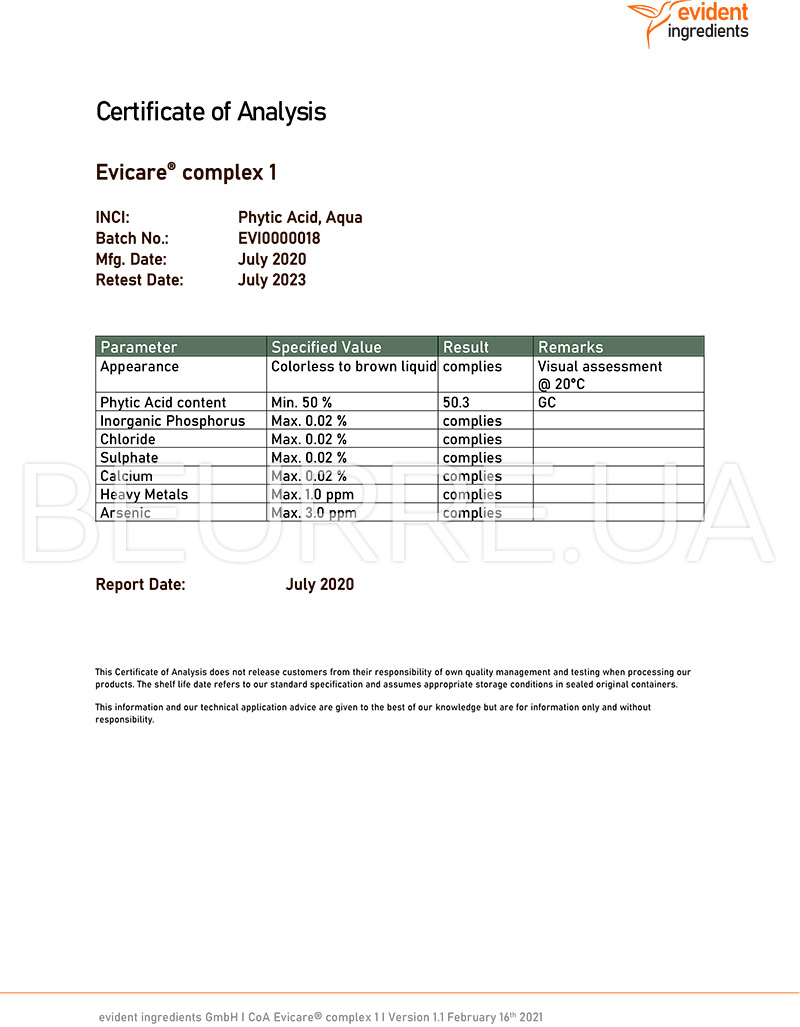
INCI: Phytic Acid, Aqua
CAS: 83-86-3, 7732-18-5
Main substance content: > 50%
Dosage (percentage of input into cosmetics): 0,1 - 0,2 %.
- 0.1% to reduce oxidation in emulsions
- 0.2% to improve foam quality in cleansing products
- up to 99% in facial peelings.
Solubility: in water
Particulars of use: phytic acid has a very acidic pH and lowers the overall acidity of the formula. Therefore, it is recommended to introduce phytic acid first, balance the pH of the formula and only then introduce the other ingredients. It is not combined with the preservative Euxyl K712.
Storage: long-term storage is recommended in a dark place at temperatures up to 25 °C, protect from direct sunlight and overheating.
Certification: Cosmoc/Ecocert approved, non-GMO, nanoparticle free, free of animal particles and suitable for vegans and vegetarians, not tested on animals. 100% vegetable origin from rice bran.
Origin of phytic acid
Phytic acid is a natural chelating agent derived from rice bran by aqueous extraction. In Asia, this natural product is used in many applications, including use as a bleaching agent. In addition, phytic acid has attracted widespread attention from cosmetic manufacturers as a natural and biodegradable chelating agent. EDTA is a synthetic product that is very popular for use as a chelator, but has been criticized in recent years due to its synthetic origin and poor biodegradability.
Phytic acid is widely used as a plant-based and biodegradable alternative to EDTA and other synthetic chelators. It and its salts (Soduim phytat) are able to work at similarly low input dosages and show high efficiency in binding metal ions. By using Evicare complex, it is possible to produce ecological cosmetics that comply with the principles of natural and organic cosmetics.
Other cosmetic properties of phytic acid
- Antioxidant: as a bioactive ingredient, phytic acid is believed to slow cell division and bind free radicals;
- powerful keratolytic;
- has anti-inflammatory properties;
- strengthens elastin and collagen fibers and improves facial contour;
- chelator;
- gentle on the skin, fast recovery.
Peels with phytic acid and features of application
Like any AHA-acid, phytic acid softens the upper stratum corneum of the skin and promotes the exfoliation of dead skin cells, cleansing follicles. The exfoliating effect of phytic acid is exactly the same as that of glycolic acid. However, phytic acid does not require neutralization. It works more slowly and only in the upper stratum corneum of the skin due to its high molecular weight. Its action is less aggressive compared to glycolic acid. In most cases, when using phytic peel, there is not even typical for acid peels burning.
An important advantage of phytin peeling - a quick recovery of the skin after the procedure. This peeling can be carried out all year round, regardless of solar activity. Experts note that in addition to skin renewal, improving the state of elastin and collagen fibers, phytic peeling is a good preventive measure and means of combating couperosis.
Peels with phytic acid are suitable for sensitive, thin or fading skin. However, they can not be carried out pregnant, lactating and people with skin diseases, diabetes mellitus, hypertensive people.
As after any peeling, sunscreen and moisturizing creams should be applied to the skin.
Chemical Hollywood phytin peel
In many sources, you can meet information that phytin peeling is also called Hollywood peeling. And there is a simple explanation for this, because stars often use a large amount of decorative cosmetics, from which the skin suffers greatly. To preserve its moisturization and youthfulness have to resort to such tricks as deep cleaning without external consequences. After all, peels with high acid content can leave redness, burns and peeling, while phytic peels do not require any rehabilitation and post-peeling care.
Phytic acid as a chelating agent
Phytic acid is considered a natural alternative to the popular chelating agent EDTA. Recently, manufacturers have been very reluctant to include this chelating agent in their formulations due to its synthetic origin and poor biodegradability. Formulations with EDTA cannot be classified as natural cosmetics and it is most often used for detergents and cleansers. But in natural cosmetics, EDTA has long been replaced by phytic acid or sodium phytate. This allows manufacturers to obtain certificates of natural and organic cosmetics, because derivatives of phytic acid are completely safe for the body. Phytic acid is highly effective even with a small percentage of input.
But it is important to remember that the chelating properties of phytic acid depend directly on the pH value in which it will work. The optimum acidity level of a finished product with phytic acid as a chelator is pH 2.0 - 4.8. Starting from the value of 2.0 will actively bind ions of copper and other metals, but already at a value of 5 calcium ions will not bind. In this case, you can pay attention to the natural chelator Dermodeel PA-12 (Soduim phytat).
Handmade cosmetics recipes and reviews
If you are new to cream making - it is very difficult to make your own right recipe. And that's where we are ready to help you. Go to youtube channel Cosmetic Kitchen Beurre, where we have already developed many recipes for handmade cosmetics and share the technology of making cosmetics with their own hands.
And also go to Beurre's Blog, where we share useful information about creating the right natural cosmetics.
| Товар | |
|---|---|
| Producer: | Evident |
| Appearance: | liquid |
| Solubility: | water soluble |
| Origin: | vegetable |
| Certification | Cosmos/Ecocert |
| Type: | decreases pH |
Viewing the analysis certificate is only available to registered users. Register or log in