

Chelating agents in cosmetics: why use them
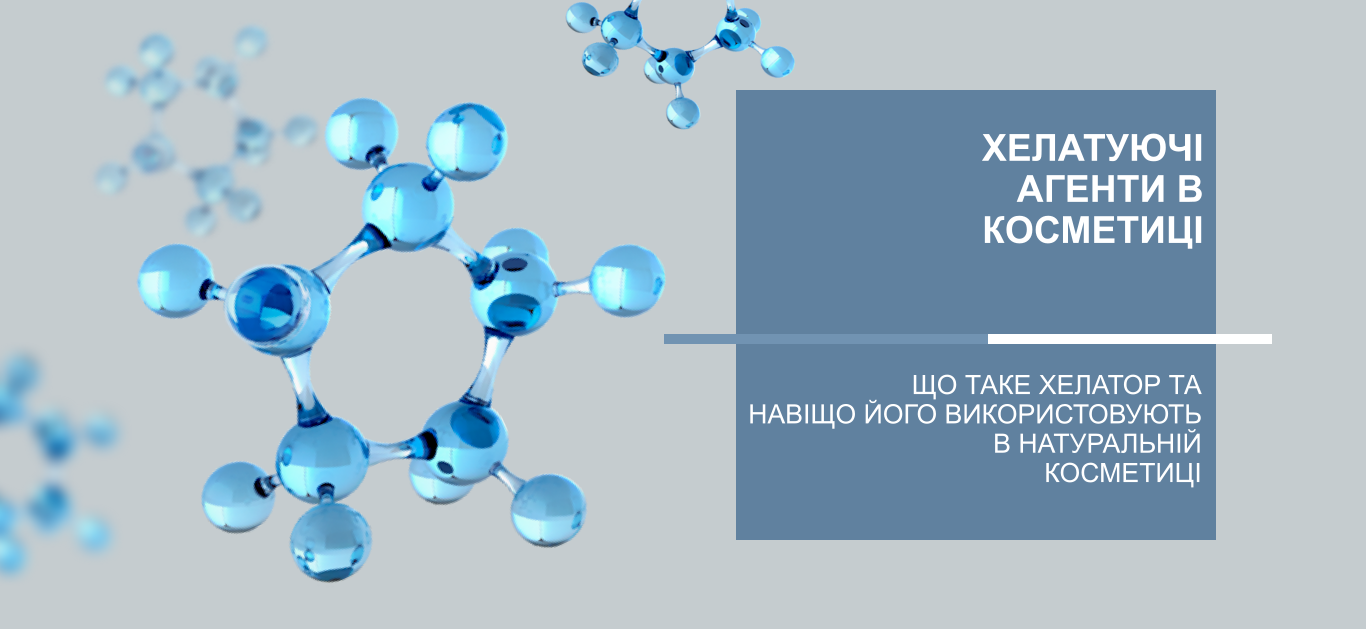
If you look at homemade cosmetics recipes, not many cream makers use chelating agents or as they are also called chelators. Many do not even know what it is. Meanwhile, leading technologists recommend including chelators in the recipe as a mandatory component along with preservatives. Let's figure it out], why do they insist so much?!
What is a chelator
A chelating substance (chelating agent, chelator, chelating agents) is a substance that can react with metal ions, resulting in the formation of chelates - compounds that are not able to react with other substances in your product. In fact, chelating substances bind metal ions, preventing them from spoiling our cosmetics.
Metal ions and their harmful properties in cosmetics
Metal ions, this can be iron, manganese, copper, get into the cream even under ideal laboratory production conditions, they can even be in the water. Remember such a concept as hard water? It is the metal ions that give it such unpleasant properties. That is why it is recommended to work with distilled or deionized water in cosmetic formulations. Metal ions can also be in the components or on the equipment.
These substances actively react with many active ingredients. Because of them, fragrances can change their smell, vitamins and fatty oils oxidize, in addition, oils can go rancid and acquire an unpleasant smell right in the cream, the color of the cosmetic product can change, some substances can precipitate after a reaction with metal ions, cosmetics can become cloudy, delaminate, and surfactants foam worse. Are you familiar with situations when the same recipe works for someone, but something always goes wrong for you?
Unfortunately, it is impossible to prevent metal ions from getting into a cosmetic product. But we can easily defeat them if we use chelating agents that can bind metal ions.
What is the role of chelators in natural cosmetics
Chelating agents neutralize the ability of metal ions to react with other components of a cosmetic product. Chelators create a new substance with metal ions - a chelate, which is absolutely harmless and inert. Hence the properties of chelators, which:
- stabilize the system as a whole, do not allow some active ingredients to precipitate
- prevent the decomposition of components and oxidation of oils
- increase the shelf life of a cosmetic product
- have additional cosmetic properties (this applies only to natural chelators).
Chelating agents and microorganisms
Chelators can not only bind iron ions, they also affect the viability of microorganisms that can somehow end up in your cosmetic product. Chelators bind iron ions that are involved in the metabolism of bacteria, thereby blocking the access of nutrients to the body of these same bacteria. Chelating agents increase the permeability of the cell membranes of harmful microorganisms and thus exhibit antimicrobial properties. That is, by adding chelators, you extend the shelf life of your products.
Synthetic and natural chelating agents
One of the most common and well-known chelators on the market is Trilon B, which can be in the form of Disodium EDTA or Tetrasodium EDTA. This component can be found in most industrial household chemicals and in cosmetics. EDTA is the simplest and cheapest chelating agent, but it is not produced from plant materials and has low biodegradability.
As a cosmetic version of a chelating agent, the Edeta B Pulver component was released, which can be purchased in the Beurre store under the name EDTA B Chelator. It is produced by the German company BASF and the component is positioned for use in all types of cosmetics, as well as in animal care cosmetics.
Considering that now more and more attention is paid to ecology and natural origin of components, natural chelators are actively developed and researched. For their production, plant materials are used and in addition to the property of binding metal ions and suppressing the growth of bacteria, they usually have "side" cosmetic properties, having a positive effect on the skin and hair.
The most famous natural chelator is phytic acid and sodium phytate. This is a completely plant component, phytic acid is found in the seeds of many plants. Its chelating properties are in no way inferior to EDTA, but at the same time the active additionally performs the following tasks: narrows pores, moisturizes and whitens the skin, normalizes sebum production, improves skin elasticity. This chelator is found under the trade name Dermofeel PA, PA-3, PA-12, in this case it is made from rice. It can also be purchased as an aqueous solution under the name Cosphaderm Econat.
GLDA 47 is a trade name for a chelator based on L-glutamic acid, which is produced from sugar beet, is completely decomposed, has low toxicity and is able to bind Ca2 + and Mg2 +, and therefore reduce water hardness. The component has high stability over a wide pH range, as well as at high temperatures. Compatible with enzymes, but incompatible with oxidizing agents. This chelator is used in the production of cosmetics, household chemicals and detergents from the Eco-series, as it has Ecocert certification.
A new generation of chelating agents includes caprylhydroxamic acid, which is used as a chelating agent and antimicrobial additive. Caprylhydroxamic acid is often included in the compositions of mixed preservatives and in the cosmetic market these mixtures are known under the trade names Spectrastat PHL and Cosphaderm LEO. This series of actives is 100% biological in origin, caprylhydroxamic acid is produced from coconut and it is able to suppress the growth of mold, yeast.
Gluconolactone is also a natural chelating agent, which belongs to hydroxy acids and in many ways repeats the properties of AHA acids. This active is able to bind iron ions. But in addition, it is a powerful antioxidant, moisturizer, and also reduces the negative impact of ultraviolet radiation on the skin. Gluconolactone is found in the Geogard Ultra preservative, which is not tested on animals, has Ecocert certification and is compatible with most types of raw materials. However, gluconolactone is not such a strong chelator when compared to sodium phytate.
How to use chelating agents in cosmetics
Chelating agents are water-soluble, their dosage is very small from 0.01 to 0.5%, here you need to read the manufacturers' recommendations for each individual component. % of input depends on the chelator itself, as well as whether it is a pure powder, or, say, an aqueous solution of powder.
There are some actives, the use of which without chelating agents is highly undesirable: for example, vitamin C, Zinc and Copper PCA. Manufacturers directly indicate that chelators should be added to the formula to stabilize the system.
Chelators work well in synergy with antioxidants. However, chelating agents will not be superfluous in any cosmetic product and you already know why.
© beurre.ua
All materials are copyrighted. It is forbidden to use (copy, distribute, modify, etc.) materials of the site beurre.ua without prior consent.